
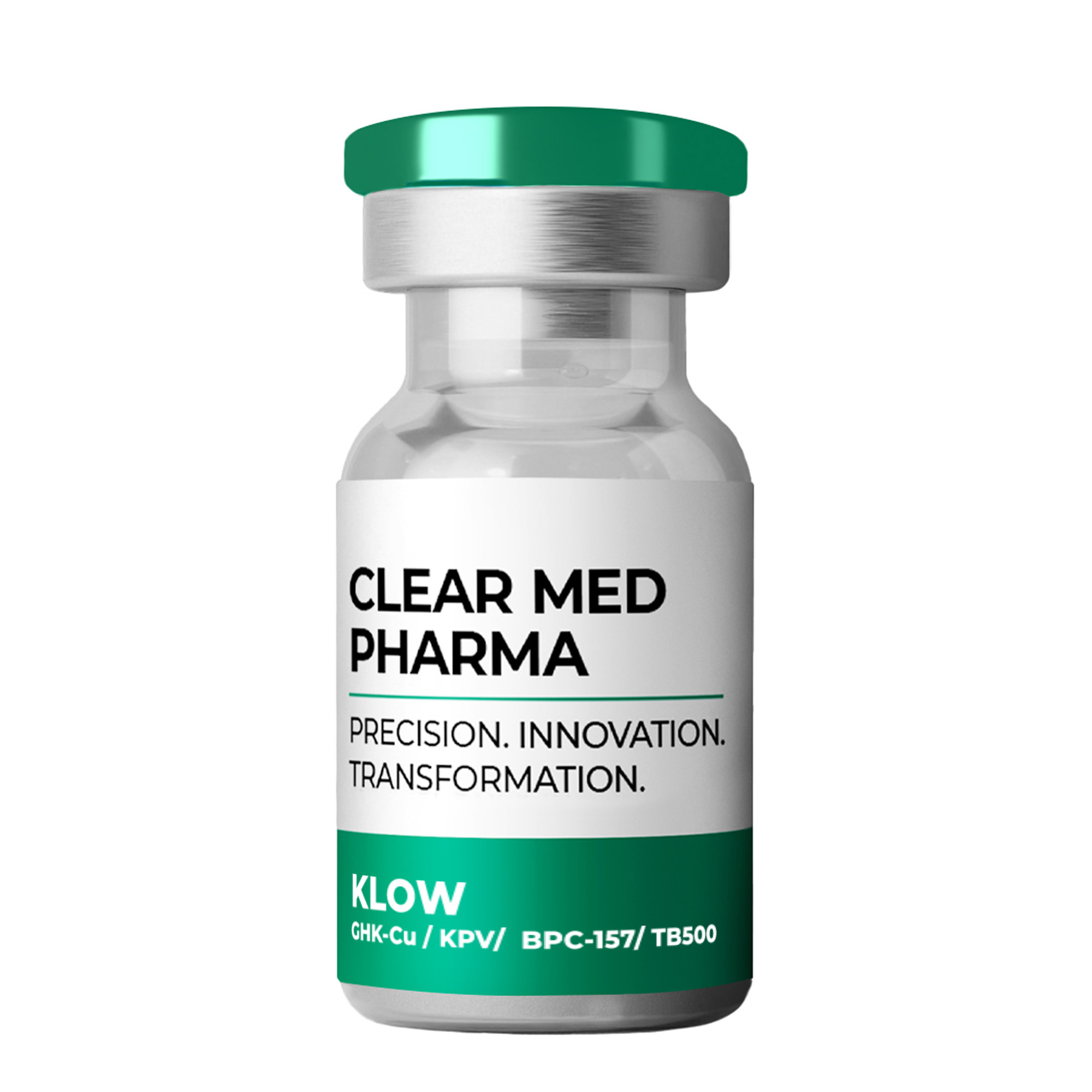

GHK-Cu (50mg) / KPV (10mg) / BPC-157 (10mg) / TB500 (10mg) – KLOW Blend 80
Login to view prices.
Existing research has found the following:
-
Supports Regenerative & Repair Research – Studied for its potential to accelerate tissue restoration and cellular renewal in experimental models.
-
Explores Anti-Inflammatory & Recovery Pathways – Investigated for its influence on inflammatory modulation and healing response mechanisms.
-
Evaluates Collagen, Skin, & Gut Integrity – Examined for its roles in promoting structural protein synthesis, epithelial repair, and barrier function.
Description
Tissue Repair and Cellular Regeneration
-
Copper tripeptide (GHK-Cu), BPC-157, and Thymosin Beta-4 (TB-500) are frequently examined in cell and animal models for their roles in modulating fibroblast activity, tissue remodeling, and wound-healing kinetics.
Inflammatory Pathway Modulation
-
KPV (tripeptide Lys-Pro-Val) and BPC-157 have demonstrated anti-inflammatory signaling effects in pre-clinicalsystems, including down-regulation of pro-inflammatory mediators and cytokine expression.
Angiogenic and Vascular Mechanisms
-
TB-500 is used experimentally to study actin sequestering and angiogenesis in non-human models, where enhanced vascular growth and nutrient delivery are observed as model-dependent outcomes.
Collagen Synthesis and Dermal Matrix Research
-
GHK-Cu is a well-characterized copper-binding peptide investigated for its ability to stimulate collagen and glycosaminoglycan production in cell culture and organotypic skin models.
Gastrointestinal Integrity Models
-
BPC-157 has been evaluated in animal systems for its potential to maintain gastric mucosal integrity and support epithelial repair following induced injury.
Immune Response Regulation
-
KPV has been used in pre-clinical assays to probe immune-modulating and antimicrobial signaling pathways through melanocortin receptor–related mechanisms.
Neural Protection and Repair Models
-
GHK-Cu and BPC-157 are under investigation for their effects on neurite outgrowth and axonal repair in neuronal cell culture and animal models.
Systems-Level Recovery Research
-
Multi-analyte combinations of these peptides are being explored for integrative effects on cellular resilience, stress response, and regeneration in non-clinical environments. Findings remain model-specific and non-translatable to clinical contexts.
STORAGE DETAILS:
Lyophilized KLOW blend is stable at room temperature for up to 90 days; however, it should not be stored below freezing for any extended period. After reconstitution, store refrigerated at temperatures not to exceed 36 °F (2 °C).
Application:
Designed as a synergistic peptide blend combining tissue-repair, anti-inflammatory, and regenerative support properties of GHK-Cu, BPC-157, TB-500, and KPV.
Appearance:
Solid, white lyophilized powder in 5 mL glass ampule.
Components & Molecular Data:
| Peptide | Chemical Formula | CAS Number | Approx. Molecular Weight |
|---|---|---|---|
| GHK-Cu | C14H24N6O4Cu | 49557-75-7 | ~340.9 g/mol |
| BPC-157 | C62H98N16O22 | 137525-51-0 | ~1419 g/mol |
| TB-500 (Thymosin Beta-4 fragment) | C212H350N56O78S | 77591-33-4 | ~4964 g/mol |
| KPV | C19H28N6O4 | 88184-00-1 | ~420 g/mol |
Synonyms:
GHK-Cu (Copper Tripeptide-1), Body Protection Compound-157, Thymosin Beta-4 fragment, α-MSH (11–13) KPV.
Storage:
Store sealed at ≤6 °C, away from heat, light, and moisture.
Concentration:
≥98% (combined peptide purity by HPLC).
Research Use Only (RUO). Not for human or animal use. Not for diagnostic or therapeutic applications. No claims are made regarding clinical benefit, healing, or performance. End-user assumes responsibility for determining suitability for specific assays or protocols.
You may also like
CJC-1295 DAC (10mg)
Login to view prices.Glutathione 1500mg
Login to view prices.IGF-1LR3 (1mg)
Login to view prices.BPC-157
Login to view prices.