
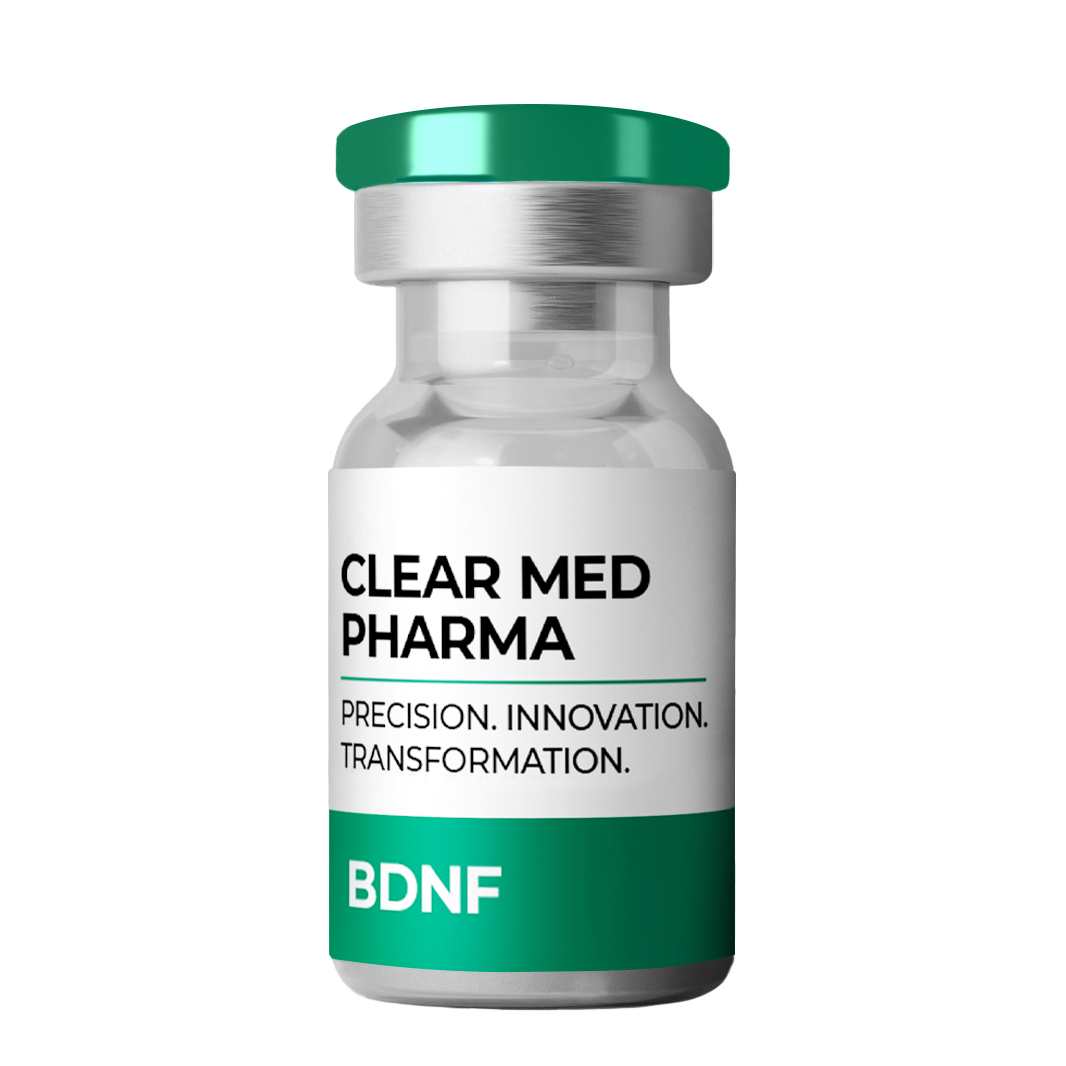

BDNF (Brain-Derived Neurotrophic Factor) (10mg)
Login to view prices.
Existing research has found the following:
-
Supports Neuroplasticity & Cognitive Research – Studied for its role in synaptic adaptation, learning, and memory formation.
-
Explores Neuronal Growth & Regeneration Pathways – Investigated for promoting neuronal survival, differentiation, and repair in experimental models.
-
Evaluates Mood & Stress Regulation Mechanisms – Examined for its influence on emotional balance and neuroendocrine signaling.
Description
Neuroplasticity and Cognitive-Function Research
-
Brain-Derived Neurotrophic Factor (BDNF) is a neurotrophin extensively studied in cellular and pre-clinicalsystems for its key role in promoting synaptic plasticity, learning, and memory formation, providing a foundation for neurocognitive and neuroadaptation research.
Neuronal-Growth and Regeneration Models
-
BDNF has been shown in in-vitro and animal studies to stimulate neuronal differentiation, dendritic growth, and axonal repair, supporting its use in research on neural development, regeneration, and neurogenesis.
Mood and Emotional-Regulation Studies
-
Experimental literature suggests BDNF may modulate serotonergic and dopaminergic pathways in the brain, allowing investigation into stress resilience, anxiety mechanisms, and mood-regulation signaling in non-clinical systems.
Neuroprotection and Cell-Survival Research
-
Pre-clinical findings indicate that BDNF supports neuronal survival under oxidative and excitotoxic stress conditions, enabling studies on neurodegeneration prevention and brain-injury protection mechanisms.
Stroke and Brain-Injury Recovery Models
-
Laboratory studies have explored BDNF’s potential to enhance synaptic remodeling and neurovascular recovery after cerebral ischemia, providing insight into mechanisms of post-stroke rehabilitation and neural repair.
Synaptic-Plasticity and Connectivity Studies
-
BDNF is a central regulator of long-term potentiation (LTP), an essential process for learning and memory consolidation, making it a key target for neuroelectrophysiology and signal-transduction research.
Motor-Function and Coordination Research
-
In animal models, BDNF has been associated with improved motor learning and coordination, supporting its use in studies on neuro-muscular adaptation and cerebellar signaling pathways.
Metabolic and Energy-Homeostasis Studies
-
Emerging research shows BDNF involvement in hypothalamic regulation of glucose and lipid metabolism, making it relevant for investigations into insulin sensitivity, energy balance, and metabolic neurobiology.
STORAGE DETAILS
Lyophilized BDNF peptide is stable at room temperature for 90 days; however, it should NOT be stored below freezing for any extended period of time. After reconstituting, BDNF should be refrigerated at temperatures not to exceed 36°F.
Product Specifications
-
Appearance: Solid, white powder in 3mL glass ampule
-
Chemical Formula: C141H228N40O45
-
PubChem CID: (Specify if available)
-
CAS Number: 9061-61-4
-
Molecular Weight: 31.4 kDa
-
Synonyms: Brain-Derived Neurotrophic Factor, BDNF, 9061-61-4
-
Storage: Store at ≤6°C, sealed, away from heat, light, and moisture.
-
Concentration: ≥98%
Research Use Only (RUO). Not for human or animal use. Not for diagnostic, therapeutic, or clinical applications. No claims are made regarding cognitive enhancement, neuro-protection, or mood regulation in humans. End-user assumes responsibility for determining suitability for specific research protocols.
You may also like
Glutathione 1500mg
Login to view prices.Semax (30mg)
Login to view prices.PT-141 (10mg)
Login to view prices.Melanotan 2 (10mg)
Login to view prices.