
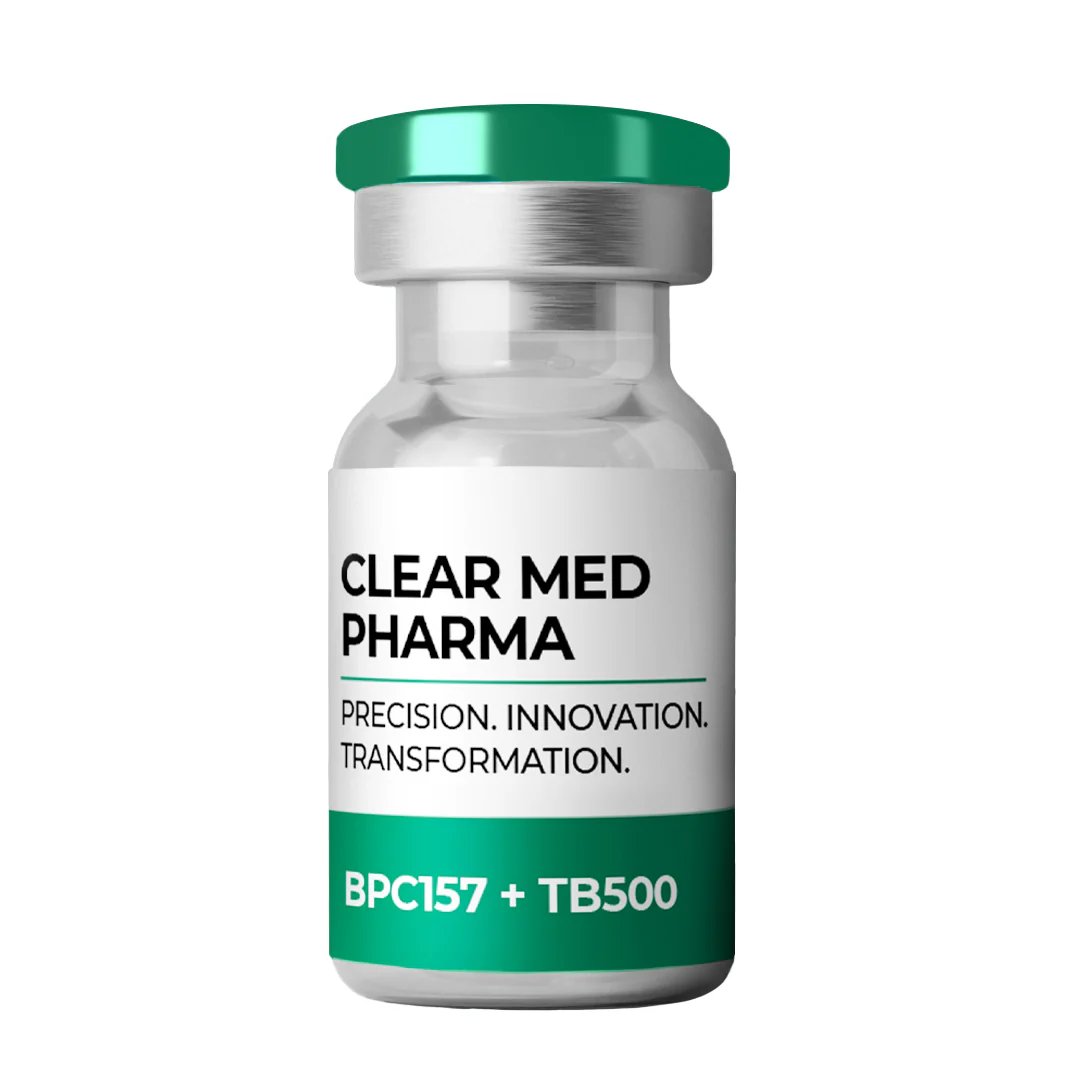

BPC-157 (10mg) / TB500 (10mg) – Wolverine Blend
Login to view prices.
Existing research has found the following:
-
Supports Tissue Repair & Regeneration Research – Studied for its potential to accelerate healing of muscle, tendon, ligament, and joint tissue.
-
Explores Cellular Growth & Recovery Mechanisms – Investigated for stimulating angiogenesis, fibroblast activity, and overall tissue restoration.
-
Evaluates Anti-Inflammatory & Joint Support Pathways – Examined for reducing inflammation, supporting cartilage integrity, and improving joint resilience in research models.
Description
Tissue-Regeneration and Repair Studies
-
The combination of BPC-157 and TB-500 (Thymosin Beta-4 fragment) is widely studied in cellular and animalmodels for its synergistic effects on tissue regeneration, angiogenesis, and cell migration during wound-healing and musculoskeletal recovery research.
Muscle, Tendon, and Ligament Repair Models
-
In pre-clinical research, this peptide blend has been shown to accelerate myoblast differentiation, fibroblast proliferation, and connective-tissue healing, making it useful in laboratory investigations of soft-tissue repair.
Inflammation and Cytokine-Modulation Research
-
Studies demonstrate that BPC-157 and TB-500 may modulate inflammatory cytokines, reducing markers of systemic inflammation in non-clinical settings. This supports their use in research on chronic inflammation and immune signaling pathways.
Cartilage and Joint-Integrity Studies
-
In animal models, both compounds promote chondrocyte regeneration and collagen synthesis, aiding research into cartilage health, joint protection, and degenerative-tissue restoration.
Angiogenesis and Vascularization Models
-
TB-500’s ability to upregulate actin-sequestering proteins and BPC-157’s pro-angiogenic activity have been shown to enhance blood-vessel formation and microcirculation, supporting research into vascular remodelingand tissue oxygenation.
Gastrointestinal and Mucosal-Healing Research
-
BPC-157 has been extensively studied in GI-tract models for its role in promoting mucosal barrier repair, ulcer protection, and epithelial-cell regeneration, offering insight into gut-healing mechanisms.
Neuroprotective and Neural-Regeneration Studies
-
Pre-clinical data indicate that the blend may promote axon regeneration, neurovascular growth, and reduction of neuroinflammatory markers, enabling exploration of neural protection and recovery after injury.
Flexibility, Mobility, and Recovery Research
-
Combined GH-independent repair signaling supports musculoskeletal flexibility, reduced stiffness, and enhanced recovery kinetics, making the blend valuable for studies in biomechanical restoration and functional tissue resilience.
Safety and Tolerability Data
-
Across animal and cell-culture studies, both peptides have demonstrated favorable toxicology profiles, supporting their use in long-term non-clinical experimentation.
STORAGE DETAILS: Lyophilized BPC157/ TB500 peptide is stable at room temperature for 90 days, however it should NOT stored below freezing for any extended period of time. After reconstituting BPC157/ TB500 should be refrigerated at temperatures not to exceed 36 F.
Application: Research peptide with potential in regenerative studies.
Appearance: Solid, white powder in 3mL glass ampule
Chemical Formula: BPC-157: C62H98N15O22, TB-500: C212H350N56O78S
PubChem CID: TB500: 16132341, BPC157: 155977614
CAS Number: BPC157: 137525-51-0, TB500: 77591-33-4
Molecular Weight: BPC-157: 556 g/mol, TB-500: 4408 g/mol
Synonyms: BPC-157: Body Protection Compound-157, TB-500: Thymosin Beta-4
Storage: Store at ≤6°C, sealed, away from heat, light, and moisture.
Concentration: ≥98%
Research Use Only (RUO). Not for human or animal use. Not for diagnostic, therapeutic, or clinical applications. No claims are made regarding tissue healing, recovery enhancement, or anti-inflammatory effects in humans. End-user assumes responsibility for determining suitability for specific research protocols.
You may also like

DSIP (5mg)
Login to view prices.CJC-1295 No DAC (10mg)
Login to view prices.PT-141 (10mg)
Login to view prices.GHK-Cu (100mg)
Login to view prices.