
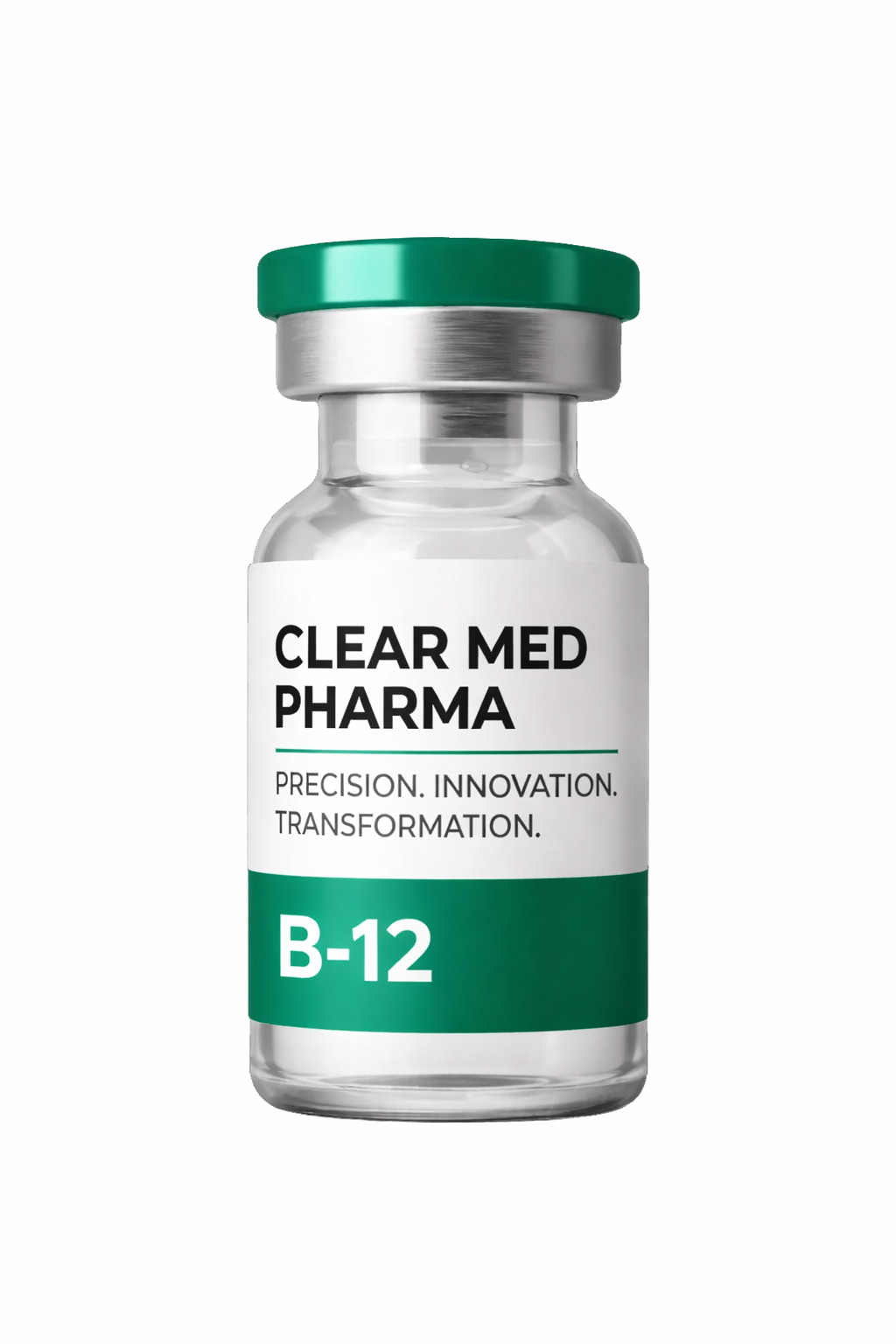

B-12 (10mg)
Login to view prices.
Existing research has found the following:
Supports Cellular Energy Metabolism Research – Studied as a critical cofactor in mitochondrial energy production and metabolic pathways, supporting efficient ATP generation in cellular models.
Explores Red Blood Cell Formation Pathways – Investigated for its role in erythropoiesis and nucleic acid synthesis, contributing to oxygen transport mechanisms in pre-clinical systems.
Evaluates Neurological Function & Methylation Balance – Examined for its involvement in myelin maintenance, neurotransmitter synthesis, and methylation pathways associated with cellular signaling and metabolic regulation.
Description
Literature-Based Summary (Non-Clinical Context)
Cobalamin-Dependent Enzymatic Activity
Vitamin B-12 (cobalamin) has been extensively studied in biochemical and cell-based models for its role as a cofactor in key enzymatic reactions, including methionine synthase and methylmalonyl-CoA mutase. These pathways are central to methylation processes, nucleotide synthesis, and cellular energy metabolism.
Methylation and DNA Synthesis Research
In non-clinical systems, Vitamin B-12 is involved in the regeneration of methionine from homocysteine, supporting S-adenosylmethionine (SAMe) production. This process is critical for DNA methylation, gene expression regulation, and cellular replication in rapidly dividing cells.
Red Blood Cell Formation Models
Pre-clinical and in-vitro research demonstrates that Vitamin B-12 plays a key role in erythropoiesis, supporting normal red blood cell maturation and nucleic acid synthesis. These models are used to study cellular proliferation and hematologic development.
Neurological Function and Myelin Research
Vitamin B-12 has been investigated in neuronal and glial cell models for its role in myelin sheath maintenance and neurochemical signaling. Research suggests involvement in pathways supporting nerve integrity and neuronal energy metabolism.
Mitochondrial Energy Pathways
Through its role in methylmalonyl-CoA conversion, Vitamin B-12 has been studied for its contribution to mitochondrial substrate utilization and ATP production. These pathways are relevant to cellular respiration and metabolic efficiency in laboratory systems.
Homocysteine Regulation Studies
In biochemical models, Vitamin B-12 has been associated with the regulation of homocysteine levels via methylation pathways, enabling research into cardiovascular-related metabolic markers and sulfur amino acid metabolism.
Cognitive and Neurochemical Research Models
Cell-based studies have explored Vitamin B-12 in relation to neurotransmitter synthesis and neuronal metabolism, supporting investigation into cognitive function, mood-related pathways, and central nervous system energetics.
Synergistic Applications
Vitamin B-12 is frequently studied in combination with folate (Vitamin B9), Vitamin B6, and NAD⁺ precursors to examine integrated methylation cycles, energy metabolism, and redox balance in multi-pathway research models.
Research Use Only (RUO). Not for human or animal use. Not for diagnostic, therapeutic, or clinical applications. No claims are made regarding energy enhancement, cognitive effects, or physiological benefits in humans. End-user assumes responsibility for determining suitability for specific research applications.
You may also like
Kisspeptin (10mg)
Login to view prices.Ipamorelin (10mg)
Login to view prices.Tesamorelin (10mg)
Login to view prices.PT-141 (10mg)
Login to view prices.